
When allegations of domestic violence arise, waiting months for a final court order may leave an aggrieved person without immediate protection. Recognising this reality, Section 23 of the Protection of Women from Domestic Violence Act, 2005 (PWDVA) empowers Magistrates to grant Urgent Relief in deserving cases.
For individuals involved in domestic violence proceedings, understanding Section 23 is essential because interim orders often have an immediate impact on residence rights, monetary relief, child custody, and protection orders.
What is Section 23 of the Protection of Women from Domestic Violence Act?
Section 23 authorises the Magistrate to pass:
- Interim orders during the pendency of the proceedings; and
- Ex parte orders, where circumstances require immediate intervention without first hearing the respondent.
The objective is to ensure that an aggrieved woman is not left without legal protection while the main application under Section 12 of the Act is being decided.
What are interim orders?
An interim order is a temporary order passed before the final disposal of the case.
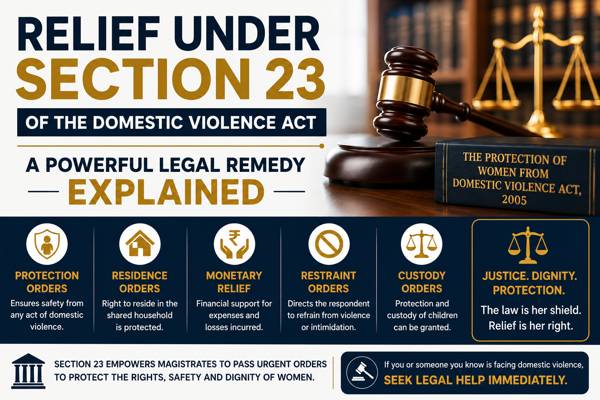
Depending upon the facts, the court may grant Urgent Relief under Section 23 of the Domestic Violence Act:
- Protection from domestic violence;
- Residence rights;
- Monetary relief;
- Temporary child custody;
- Other reliefs available under the Act.
These orders remain effective until modified, vacated, or replaced by the final judgment.
What Is an Ex Parte Order?
An ex parte order is passed without issuing prior notice to the respondent where the Magistrate is satisfied that immediate intervention is necessary.
However, such orders are not automatic.
The Magistrate must record satisfaction that there are sufficient grounds to grant urgent relief based on the affidavit and materials placed before the court.
Once the respondent appears, they are entitled to seek modification, variation, or vacation of the interim order by presenting their defence.
When Can Section 23 Be Invoked?
Courts generally consider interim relief where there appears to be an urgent need for protection, such as:
- Allegations of physical abuse;
- Threats of dispossession from the shared household;
- Immediate financial hardship;
- Protection of minor children;
- Prevention of further acts of domestic violence.
Each application is decided on its own facts, and the court exercises judicial discretion after considering the available material.
Is Evidence Required?
Although Section 23 provides for speedy relief, interim orders are not intended to be granted mechanically.
Applicants should place sufficient material before the court, including:
- A detailed affidavit;
- Medical records, where available;
- Police complaints;
- Photographs;
- Electronic communications;
- Witness details;
- Financial documents supporting claims for monetary relief.
Similarly, respondents have the right to challenge unsupported allegations by filing objections and placing contrary evidence before the court.
Can Interim Orders Be Challenged?
Yes.
A respondent who believes that an interim or ex parte order has been passed without adequate material or in violation of legal principles may seek appropriate remedies before the competent court.
Courts have repeatedly held that interim orders should be based on prima facie satisfaction and cannot substitute a final determination of disputed facts.
Practical Importance of Section 23
Section 23 plays a significant role because domestic violence proceedings often take time to conclude.
Without interim protection, an aggrieved person may suffer irreparable hardship during the pendency of litigation. At the same time, courts are expected to ensure that interim relief does not become a substitute for a final adjudication or operate unfairly against the respondent without sufficient material.
The provision therefore seeks to balance urgent protection with procedural fairness, ensuring that immediate relief is available while preserving the respondent’s right to contest the allegations.
Key Judicial Principles
Courts interpreting Section 23 have consistently emphasised:
- Interim relief is discretionary, not automatic.
- Ex parte orders should be granted only where immediate circumstances justify such relief.
- The applicant must establish a prima facie case.
- The respondent must be allowed to contest the order at the earliest stage.
- Interim orders remain subject to modification or cancellation based on subsequent evidence.
Conclusion
Section 23 of the Protection of Women from Domestic Violence Act, 2005 serves as a powerful procedural safeguard, enabling courts to provide immediate protection where circumstances genuinely warrant urgent intervention. At the same time, it is equally important that such powers are exercised cautiously and on the basis of credible material.
Whether you are seeking interim protection or defending against an ex parte order, obtaining timely legal advice is crucial. Proper documentation, prompt action, and a clear understanding of your legal rights can significantly influence the outcome of proceedings under the Domestic Violence Act.
The above article is for information purposes only.
You may contact us for consultation or advice by visiting Contact Us