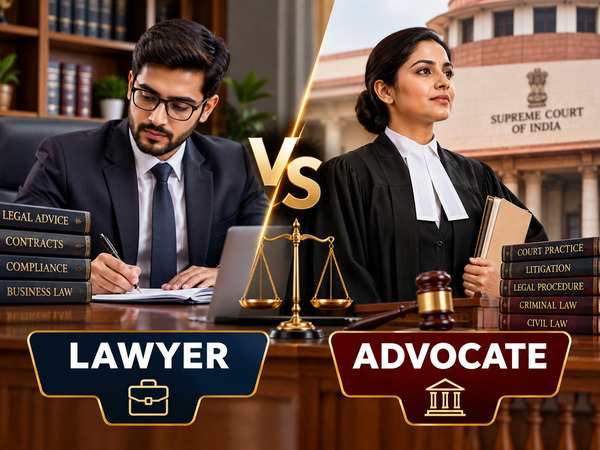
Difference Between a Lawyer and an Advocate in India is an important distinction for anyone looking for legal help, choosing a legal career, or simply trying to understand who can represent a person before an Indian court.
In everyday conversation, people often use the words lawyer and advocate as if they mean the same thing. You may tell someone, “I need a lawyer,” while the person handling your case may officially be an advocate enrolled with a State Bar Council. This difference may seem technical, but it matters when you hire legal counsel, check whether someone can appear in court, or understand a legal practitioner’s professional status.
Under the Advocates Act, 1961, advocates form the recognised class of persons entitled to practise the profession of law, subject to the Act and applicable rules. An advocate whose name is entered on a State roll has statutory rights to practise, subject to applicable requirements and court rules.
Overview: Lawyer vs Advocate in India
| Point | Lawyer | Advocate |
|---|---|---|
| General meaning | Broad term for a person trained in law | Legally recognised legal professional under the Advocates Act |
| Law degree | Usually required | Required for enrolment, subject to statutory conditions |
| Bar Council enrolment | Not necessarily | Required to practise as an advocate |
| Court appearance | Depends on legal status and applicable rules | Generally entitled to practise subject to applicable rules |
| Professional regulation | Depends on role | Regulated by Bar Councils and professional rules |
| Can represent clients in court? | Not merely because the person has an LL.B. | Yes, subject to applicable court rules |
What Is a Lawyer in India?
The word lawyer is commonly used as a broad, informal term for someone with legal education or who works in the legal field.
For example, an LL.B. graduate working in a corporate legal department, compliance team, legal consultancy, contract-management role or another legal position may commonly be called a lawyer.
However, simply having a law degree does not automatically mean that a person has the statutory right to practise before courts as an advocate.
This is one of the most important points in understanding the clear difference between a lawyer and an advocate in India.
What Is an Advocate in India?
An advocate is a legal professional enrolled with a State Bar Council under the Advocates Act, 1961, and subject to the regulatory framework governing advocates.
Sections 29, 30 and 33 of the Advocates Act are particularly important. Section 29 recognises advocates as the class entitled to practise the profession of law. Section 30 gives advocates whose names are entered on the State roll the right to practise throughout India, subject to the Act. Section 33 generally restricts practice before courts and authorities to persons enrolled as advocates, unless an exception applies.
Therefore, an advocate is not simply someone who has studied law. Bar Council enrolment is a key distinction.
Clear Difference Between a Lawyer and an Advocate in India: The Practical Test
Suppose a person tells you:
“I have completed my LL.B. and I am a lawyer.”
That statement alone does not tell you whether the person is entitled to appear and practise as an advocate before a court.
A practical question is:
Is the person’s name enrolled on a State Bar Council roll as an advocate?
If yes, the person falls within the statutory framework applicable to advocates.
This distinction becomes especially important when hiring someone for a criminal case, divorce proceeding, matrimonial dispute, property litigation, consumer matter or constitutional case.
Does Every Advocate Have to Appear in Court?
No.
An advocate may work in litigation or in non-litigation areas. Legal practice can include legal opinions, drafting agreements and pleadings, negotiations, conferences and other professional legal work.
The Supreme Court in Bar Council of India v. A.K. Balaji recognised that the practice of law is broader than simply appearing in court and includes both litigation and non-litigation work.
Bar Council of India v. A.K. Balaji — Supreme Court judgment
Therefore, an advocate working primarily on contracts or legal advisory matters does not stop being an advocate just because they do not regularly appear in court.
Can a Law Graduate Directly Practise in Court?
Generally, no.
Obtaining an LL.B. degree and becoming entitled to practise as an advocate are separate stages.
A person who wants to practise as an advocate must satisfy the applicable statutory and Bar Council requirements, obtain enrolment and comply with the rules governing legal practice.
Additional requirements may also apply for appearing before particular courts. For example, the Supreme Court has its own framework concerning Advocates-on-Record.
The Delhi High Court has also explained the significance of Sections 29, 30 and 33 of the Advocates Act while discussing the statutory exclusivity of legal practice.
Delhi High Court judgment discussing Sections 29, 30 and 33 of the Advocates Act
Lawyer vs Advocate: Which One Should You Hire?
For a court case, do not rely only on the label “lawyer.”
Before engaging a legal professional, consider:
- Whether the person is enrolled with a State Bar Council.
- Whether they regularly handle cases similar to yours.
- Whether they have experience before the relevant court or tribunal.
- Whether they clearly explain fees and professional responsibilities.
- Whether you receive proper documentation and communication about your case.
The most important issue is not the title used in conversation. It is whether the professional has the appropriate legal status, experience and authority for the work you need.
Lawyer and Advocate: The Simple Rule to Remember
The easiest way to understand the clear difference between a lawyer and an advocate in India is this:
A lawyer is a broad, commonly used term, while an advocate is a legally recognised category of legal professional under the Advocates Act, 1961, whose name is entered on the relevant State roll.
So, every advocate can be described as a lawyer, but not every person called a lawyer is necessarily an enrolled advocate entitled to practise before courts.
FAQs
1. Is an LL.B. graduate automatically an advocate?
No. Completing an LL.B. does not by itself make a person an enrolled advocate. The person must satisfy the applicable requirements for enrolment with a State Bar Council.
2. Can a lawyer who is not enrolled with a Bar Council appear in court?
Generally, a person cannot practise before a court or authority merely because they possess an LL.B. The Advocates Act provides the statutory framework for who may practise, subject to specific exceptions.
3. Is an advocate the same as a lawyer?
In ordinary conversation, people often use the terms interchangeably. Legally, however, the Advocates Act, 1961 gives an advocate a more specific meaning.
4. Can an advocate work without appearing in court?
Yes. Advocates may undertake non-litigation legal work, including legal opinions, drafting, negotiations and other legal services, subject to applicable professional rules.
Disclaimer: This article is intended for general legal information and does not constitute legal advice. The law may change depending on subsequent judicial decisions or legislative amendments. Seek professional legal advice for a specific matrimonial dispute.
You may contact us for consultation or advice by visiting Contact Us