Grounds for Divorce in India depend on the personal law governing the marriage. Divorce is not granted merely because spouses are unhappy with their marriage. A spouse must generally establish a legally recognised ground before a contested divorce can be granted, while mutual consent divorce follows a separate statutory route.
For Hindu marriages, Section 13 of the Hindu Marriage Act, 1955 (HMA) sets out the principal grounds. Similar but not identical grounds are available under the Special Marriage Act, the Divorce Act, the Parsi Marriage and Divorce Act, and Muslim personal law.
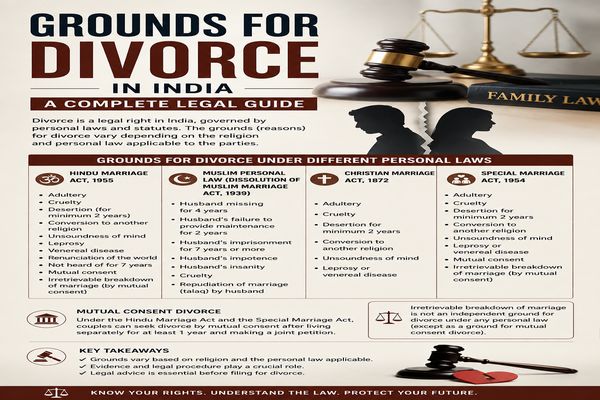
Grounds for Divorce in India Under Hindu Law
The following are the principal grounds for divorce in India under Section 13 of the HMA:
Adultery: Where a spouse voluntarily has sexual intercourse with a person other than their spouse after marriage, the other spouse can seek divorce on the ground of adultery.
Cruelty: Cruelty may be physical or mental. Conduct that causes serious mental suffering, humiliation, harassment or makes it unreasonable to expect the parties to continue living together may constitute matrimonial cruelty.
The Supreme Court has repeatedly emphasised that mental cruelty must be assessed according to the facts and circumstances of each marriage. The landmark judgment Samar Ghosh v. Jaya Ghosh provides important guidance on mental cruelty and its various manifestations. Read the Supreme Court judgment in Samar Ghosh v. Jaya Ghosh
Desertion: Desertion means abandonment of the petitioner by the other spouse without reasonable cause and without consent, with the intention of ending the matrimonial relationship. Under Section 13(1)(ib), desertion must ordinarily continue for at least two years immediately before filing the divorce petition.
Conversion: A spouse may seek divorce where the other spouse has ceased to be a Hindu by converting to another religion.
Mental Disorder: Divorce may be sought where the respondent suffers from mental disorder of such a nature and extent that the petitioner cannot reasonably be expected to live with them.
The law does not treat every mental-health difficulty as a ground for divorce. The statutory test concerns the nature and extent of the disorder and its impact on matrimonial life.
Communicable Venereal Disease: A spouse may seek divorce where the other spouse is suffering from a communicable venereal disease, subject to the statutory requirements applicable to the case.
Renunciation of the World: Where a spouse has renounced the world by entering a religious order, the other spouse may seek dissolution of the marriage.
Presumption of Death: If a spouse has not been heard of as being alive for a period of seven years or more by persons who would naturally have heard from them, divorce may be sought on this ground.
Additional Grounds Available to a Hindu Wife
Section 13(2) provides certain additional grounds on which a wife can seek divorce, including:
- The husband having been guilty of rape, sodomy or bestiality after marriage.
- A decree or order for maintenance having been passed in favour of the wife under applicable law, followed by no resumption of cohabitation for the prescribed period.
- In certain circumstances, where the marriage took place before the wife attained the prescribed age and she repudiated the marriage within the statutory period.
Divorce After Judicial Separation or Restitution Proceedings
Section 13(1A) also permits divorce where, after a decree for judicial separation, there has been no resumption of cohabitation for the prescribed period.
Similarly, failure to resume cohabitation after a decree for restitution of conjugal rights for the statutory period can become a ground for divorce.
Mutual Consent Divorce
Section 13B of the Hindu Marriage Act governs divorce by mutual consent. Both spouses must jointly state that they have been living separately for the statutory period, cannot live together and mutually agree that the marriage should be dissolved.
Mutual consent divorce is fundamentally different from a contested divorce because the court does not decide matrimonial fault in the same manner as it does in a contested proceeding.
Grounds for Divorce in India Under Other Laws
The exact grounds vary according to the law applicable to the marriage.
Special Marriage Act, 1954: Section 27 contains grounds broadly covering adultery, cruelty, desertion, imprisonment, mental disorder, communicable disease, disappearance and other specified circumstances, along with additional grounds available to a wife.
Divorce Act, 1869: Christian marriages are governed by the Divorce Act, which provides statutory grounds including adultery, conversion, cruelty, desertion, unsoundness of mind and other specified matrimonial circumstances.
Parsi Marriage and Divorce Act, 1936: The Act contains specific statutory grounds including adultery, cruelty, desertion, imprisonment, non-consummation and other circumstances prescribed by law.
Muslim marriages: A Muslim wife may seek dissolution under the Dissolution of Muslim Marriages Act, 1939, including grounds relating to disappearance of the husband, failure to maintain, imprisonment, failure to perform marital obligations, impotence, cruelty and other statutory circumstances.
Is Irretrievable Breakdown a Ground for Divorce?
Irretrievable breakdown of marriage is not presently a statutory ground for divorce under the Hindu Marriage Act. However, in exceptional cases, the Supreme Court has exercised its powers under Article 142 of the Constitution to dissolve marriages that have completely broken down.
The Supreme Court has also considered prolonged separation and a marriage that has become beyond repair while examining mental cruelty. Therefore, long separation can be legally relevant, but it does not automatically give a litigant a statutory right to divorce before a Family Court.
The Delhi High Court has specifically held that Family Courts and High Courts cannot independently grant divorce solely on the ground of irretrievable breakdown, as that extraordinary power under Article 142 belongs to the Supreme Court. Read the Delhi High Court judgment in D v. A
How Grounds for Divorce Can Be Used in Matrimonial Cases
The grounds for divorce in India are also important in related matrimonial litigation. Facts supporting cruelty, desertion, adultery or other matrimonial misconduct may become relevant in proceedings concerning:
- Divorce and judicial separation
- Restitution of conjugal rights
- Maintenance and permanent alimony
- Child custody and visitation
- Domestic violence proceedings
- Matrimonial criminal proceedings
- Interim applications and injunctions
- Appeals against matrimonial judgments
However, the same allegation does not automatically establish every legal claim. Each proceeding has its own statutory requirements and evidentiary standards.
Evidence Required in Divorce Proceedings
A successful divorce case generally depends on specific pleadings and reliable evidence. Depending on the ground, relevant evidence may include messages, emails, photographs, medical records, financial documents, travel records, correspondence, police or court records and testimony from relevant witnesses.
Courts generally examine the overall matrimonial conduct and surrounding circumstances, rather than deciding a case on isolated allegations.
Conclusion
The Grounds for Divorce in India provide the legal framework through which a spouse can seek dissolution of marriage. Cruelty, adultery, desertion, conversion, specified mental disorders, certain communicable diseases, renunciation and presumed death are among the principal statutory grounds under Hindu law, while additional grounds may apply to wives.
Because matrimonial laws differ by the nature of the marriage and the personal law applicable to the parties, choosing the correct legal ground and presenting appropriate evidence is crucial.
Disclaimer: This article is intended for general legal information and does not constitute legal advice. The law may change depending on subsequent judicial decisions or legislative amendments. Seek professional legal advice for a specific matrimonial dispute.
You may contact us for consultation or advice by visiting Contact Us