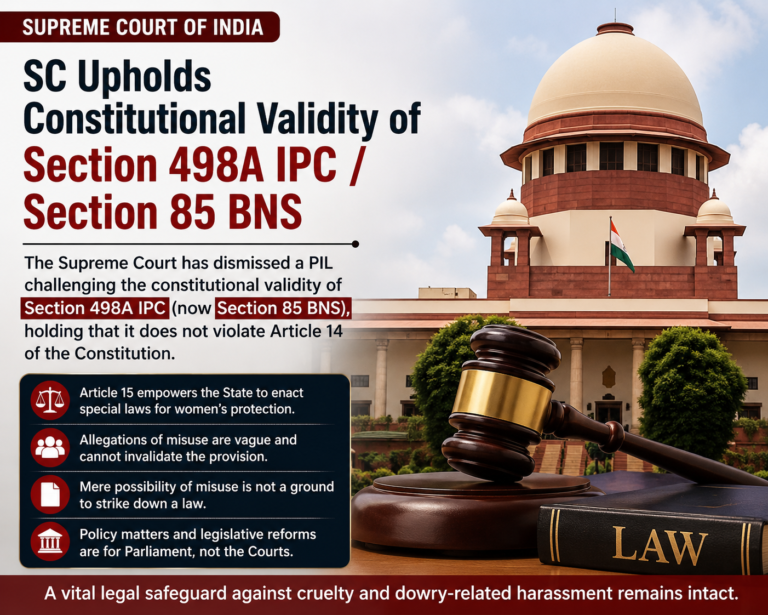
The Supreme Court on in-laws in marital disputes has once again flagged a growing concern. In a recent order, the apex court expressed strong disapproval of the routine practice of dragging relatives into criminal cases that arise purely from marital discord.
A Bench of Justices J.B. Pardiwala and K. Vinod Chandran quashed a POCSO case registered against a paternal aunt. The complaint had been filed by the child’s mother amid a bitter custody battle following a mutual-consent divorce in 2023.
Supreme Court on In-Laws in Marital Disputes: Key Observations
The Court noted that it has become “commonplace, nay customary” for in-laws to be dragged into criminal proceedings to settle personal scores. It also observed that children are frequently used as instruments to vilify the other side.
In this case, the FIR was filed only a few hours after the father had lodged a similar complaint against the maternal side of the family. No allegation of the kind was raised at the time of divorce or during the intervening period. The child’s statement recorded under Section 164 CrPC also did not support the claims made by the mother.
The Supreme Court held that the FIR did not inspire confidence and that continuing the proceedings would serve no purpose other than harassment.

Why Courts Are Increasingly Cautious
This ruling continues a consistent line of judicial thinking. Courts have repeatedly held that vague or omnibus allegations against relatives of the husband or wife cannot form the basis of criminal prosecution.
Two landmark decisions illustrate this approach clearly:
- In Geeta Mehrotra v. State of U.P. (2012), the Supreme Court quashed proceedings under Section 498A IPC against relatives where the allegations were general and lacked specific instances of involvement. Read the judgment here
- The Delhi High Court has similarly quashed multiple 498A cases against in-laws when the complaints contained only sweeping accusations without concrete details of individual acts. See a representative Delhi High Court order
These decisions reinforce that criminal law should not be used as a tool for pressure or revenge in family disputes.
Takeaway for Families and Practitioners
The latest observation by the Supreme Court on in-laws in marital disputes serves as a reminder that genuine cases of abuse must be prosecuted firmly, while false or retaliatory complaints must be nipped in the bud. Courts are increasingly willing to examine the timing, context, and supporting material before allowing trials against extended family members to proceed.
At Riz Legal, we closely monitor such developments to advise clients on both prevention and defence strategies in matrimonial and related criminal matters.
You may contact us for consultation or advice by visiting Contact Us