Marriage is intended to be a lifelong partnership, but not every relationship survives the test of time. When reconciliation is no longer possible, Indian law provides legal mechanisms for ending a marriage with dignity and fairness. Understanding the types of divorce in India is essential for anyone considering separation or seeking legal advice.
1. Divorce by Mutual Consent
A mutual consent divorce is one of the most peaceful and efficient ways to dissolve a marriage.
Under Section 13B of the Hindu Marriage Act, 1955, spouses who mutually agree that their marriage has irretrievably broken down may jointly seek divorce after settling issues relating to child custody, maintenance, alimony, and property.
Similarly, mutual consent divorce is also available under the Special Marriage Act, 1954 for couples married under that Act.
2. Contested Divorce
Where one spouse seeks divorce but the other refuses, the matter proceeds as a contested divorce.
Under the Hindu Marriage Act, recognised grounds include:
- Cruelty
- Adultery
- Desertion
- Conversion
- Mental disorder
- Renunciation of the world
- Presumption of death
- Other statutory grounds applicable under the Act
The spouse seeking divorce must establish the grounds for divorce before the Family Court.
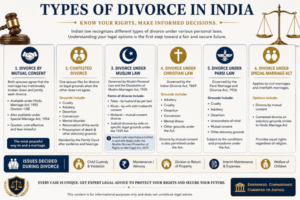
3. Divorce Under Muslim Law
Divorce among Muslims is governed by Muslim Personal Law and the Dissolution of Muslim Marriages Act, 1939.
A Muslim marriage may be dissolved in several ways, including:
- Talaq (divorce initiated by the husband in accordance with law)
- Khula (divorce sought by the wife with the husband’s consent)
- Mubarat (mutual divorce by agreement)
- Judicial divorce under the Dissolution of Muslim Marriages Act, 1939, on specified legal grounds.
Following the enactment of the Muslim Women (Protection of Rights on Marriage) Act, 2019, instant triple talaq (Talaq-e-Biddat) has been declared void and illegal.
4. Divorce Under Christian Law
Christians in India are governed primarily by the Indian Divorce Act, 1869.
A Christian spouse may seek divorce on statutory grounds such as:
- Adultery
- Cruelty
- Desertion
- Conversion
- Mental illness
- Other grounds recognised under the Act
The law also permits divorce by mutual consent, enabling couples to dissolve their marriage amicably where legal requirements are fulfilled.
5. Divorce Under Parsi Law
Parsi marriages are governed by the Parsi Marriage and Divorce Act, 1936.
The Act provides for divorce on several grounds, including cruelty, adultery, desertion, unsoundness of mind, and mutual consent, subject to statutory requirements.
6. Divorce Under the Special Marriage Act
The Special Marriage Act, 1954 governs civil and interfaith marriages.
Couples married under this Act may seek:
- Mutual consent divorce; or
- Contested divorce on statutory grounds similar to those available under the Hindu Marriage Act.
Issues Decided During Divorce
Apart from dissolving the marriage, courts may also decide:
- Child custody and visitation
- Permanent alimony and maintenance
- Interim maintenance
- Division or return of matrimonial property
- Litigation expenses
- Welfare of minor children
Which Type of Divorce Is Better?
There is no universal answer.
When both spouses are willing to resolve disputes amicably, a mutual consent divorce is generally faster, less expensive, and less emotionally taxing.
Where serious disputes exist, or one spouse contests the proceedings, a contested divorce may become necessary to protect legal rights.
Conclusion
India’s family laws recognise that different communities are governed by different legal frameworks for marriage and divorce. Whether the marriage falls under the Hindu Marriage Act, the Special Marriage Act, the Indian Divorce Act, the Parsi Marriage and Divorce Act, or Muslim Personal Law, understanding the applicable procedure is the first step towards protecting your legal rights.
Obtaining timely legal advice can help individuals navigate divorce proceedings efficiently while safeguarding their interests regarding maintenance, child custody, and matrimonial property.
Disclaimer: This article is intended for general informational purposes only and should not be treated as legal advice. For guidance on a specific matter, please click on Contact Us.