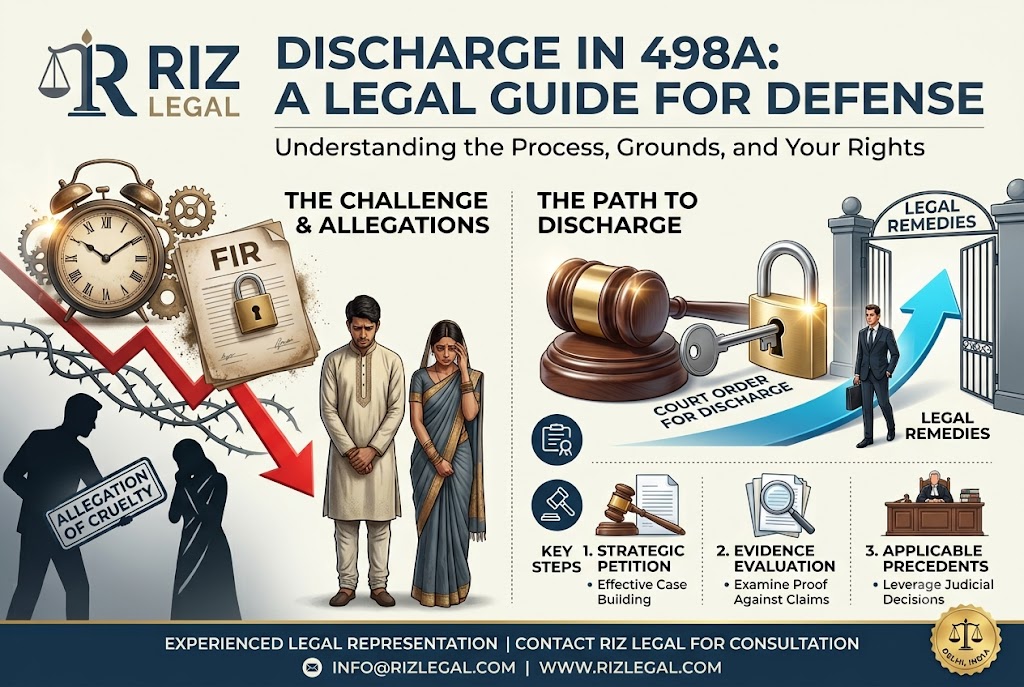
Discharge in 498A can prevent an accused from being forced into a full criminal trial when the prosecution material itself fails to disclose the ingredients of cruelty. After the chargesheet, the court does not decide guilt or innocence; it examines whether the material legally justifies framing a charge.
For cases under the old IPC, Section 498A remains relevant where the proceeding is governed by the earlier criminal procedure. For offences under the new criminal laws, Section 85 of the Bharatiya Nyaya Sanhita (BNS) corresponds to Section 498A, while Section 86 defines “cruelty”. The procedural route may be under Section 239 CrPC or Section 262 BNSS, depending on which procedural law governs the case.
What Is Discharge in 498A?
Discharge is a pre-trial remedy. In a warrant case instituted on a police report, the Magistrate examines the police report and accompanying material to determine whether the charge is groundless. Under Section 262 BNSS, an accused may seek discharge within 60 days from the supply of documents under Section 230 BNSS. Older proceedings may continue under the CrPC because of the BNSS savings provision.
A chargesheet is not a conviction. Effective 498A Discharge Relief focuses on the prosecution’s own record and asks whether the allegations satisfy the statutory ingredients.
When Can Discharge in 498A Be Sought?
A strong application normally identifies a legal gap rather than simply asserting that the complaint is false.
First, the allegations may describe ordinary marital disagreements, incompatibility, arguments, or isolated conduct without showing the level of cruelty contemplated by Section 498A IPC or Sections 85–86 BNS.
Second, allegations may be vague or omnibus. This is particularly important where parents, siblings or other relatives are implicated without a specific date, incident, demand, act of harassment or individual role.
Third, a dowry allegation must have the necessary statutory connection. The defence should examine what was allegedly demanded, who made the demand, when and where it was made, and what harassment allegedly followed.
Fourth, accompanying offences such as Section 406 IPC should be tested separately. Allegations concerning stridhan should be examined for entrustment, dominion, dishonest misappropriation and the particular accused’s connection with the alleged offence.
The Supreme Court in Kahkashan Kausar @ Sonam v. State of Bihar cautioned against continuing criminal proceedings based merely on general and omnibus allegations against matrimonial relatives where no specific role is attributed. This principle can support Discharge in 498A, particularly for relatives whose alleged involvement is not individually established.
How Courts Exercise Their Powers and Flexibility
The discharge court has an important but limited role. It can examine the prosecution record to determine whether there is sufficient ground for proceeding, but it should not conduct a mini-trial or decide disputed questions of fact as though the entire evidence has already been tested.
Discharge in 498A requires a careful balance: the court may assess the prosecution material, but should not conduct a full trial or decide disputed defence evidence. The decisive question is whether the material crosses the threshold for framing the particular charge.
A useful recent illustration is Vandana v. State (NCT of Delhi), Delhi High Court, 13 July 2026. The High Court upheld the discharge of four matrimonial relatives under Sections 498A, 406 and 34 IPC after finding that the allegations were predominantly general and omnibus and did not attribute specific dowry-related cruelty or entrustment of stridhan to those accused.
Discharge, Quashing and Acquittal
Discharge in 498A should not be confused with quashing or acquittal.
Discharge occurs before the trial begins, when the competent trial court finds that the prosecution material does not justify framing the charge.
Quashing is generally sought before the High Court under its inherent jurisdiction—principally Section 528 BNSS for new proceedings, corresponding to Section 482 CrPC. It may be appropriate where continuing the criminal case would amount to an abuse of process, or where the allegations, even taken at face value, do not constitute the offence.
Acquittal follows a trial and means that the prosecution has failed to prove the charge to the required standard.
These remedies can sometimes provide alternative routes to Discharge in 498A depending on the stage, record and facts of the case.
Use in Divorce and Other Matrimonial Proceedings
Discharge in 498A is not limited to the criminal case. A matrimonial dispute may simultaneously involve divorce proceedings, domestic violence proceedings, maintenance claims, child-custody litigation, Section 406 allegations and proceedings under the Dowry Prohibition Act.
The FIR, chargesheet, witness statements and court orders may become relevant in divorce proceedings where the parties dispute cruelty, harassment, desertion or other matrimonial conduct.
However, discharge is not automatically a judicial declaration that the complaint was false. It means the prosecution material did not cross the threshold for that particular criminal charge. Its effect on connected matrimonial proceedings depends on the order and the facts.
A careful lawyer should therefore avoid taking inconsistent positions across the criminal and matrimonial cases. Review statements, pleadings, and evidence together before deciding whether to seek discharge, quashing, modification of pleadings, or another remedy.
Practical Checklist for Discharge in 498A
Before filing, examine:
- FIR and original complaint
- Chargesheet and police report
- Statements recorded during investigation
- Supplementary statements
- Medical and electronic material relied upon by the prosecution
- Specific allegations against each accused
- Particulars of any alleged dowry demand
- Dates, places and circumstances of alleged incidents
- Ingredients of Section 498A IPC or Sections 85–86 BNS
- Any Section 406 IPC or Dowry Prohibition Act allegations
- Whether CrPC or BNSS governs the proceedings
- Date on which documents were supplied, where Section 262 BNSS applies
- Relevant Supreme Court and High Court authorities
The strongest Discharge in 498A application is usually concise, accused-specific and ingredient-based. Rather than trying to prove the entire defence at the pre-trial stage, it should show precisely why the prosecution’s own material does not establish the legal ingredients of the charge.
Kahkashan Kausar @ Sonam v. State of Bihar — Supreme Court of India
Vandana v. State (NCT of Delhi) — Delhi High Court, 13 July 2026
Legal Disclaimer: This article is for general legal awareness and does not constitute legal advice. Maintenance and set-off issues depend on the facts, applicable law, and the precise wording of the orders passed in each case.
You may contact us for consultation or advice by visiting Contact Us