Senior Citizen Eviction Rights have received an important clarification from the Delhi High Court. The Court has held that a senior citizen can seek eviction of a daughter-in-law from the senior citizen’s property on the ground of ill-treatment, even without filing a separate claim for maintenance under the Maintenance and Welfare of Parents and Senior Citizens Act, 2007.
The ruling came in Punam v. Divisional Commissioner, GNCT of Delhi & Ors., where a Division Bench comprising Chief Justice Devendra Kumar Upadhyaya and Justice Tejas Karia examined the relationship between the maintenance provisions of the Senior Citizens Act and the eviction mechanism under the Delhi Maintenance and Welfare of Parents and Senior Citizens Rules, 2009.
The judgment is significant for elderly parents involved in matrimonial or family disputes where their residence, property, and personal security become contested issues.
Senior Citizen Eviction Rights Are Independent of Maintenance Proceedings
The Delhi High Court specifically clarified that proceedings for eviction under Rule 22(3)(1) of the 2009 Rules are independent of proceedings seeking maintenance under Sections 4 and 5 of the Senior Citizens Act.
In simple terms, a senior citizen does not necessarily have to first approach the Maintenance Tribunal and establish a maintenance claim before seeking protection of his or her property through the eviction mechanism.
The Court noted that Rule 22(3)(1) permits a senior citizen or parent to seek eviction in circumstances involving non-maintenance or ill-treatment. The provision connects not only to the State Government’s rule-making powers under Section 32 of the Act, but also to Section 22, which specifically contemplates a comprehensive action plan to protect the life and property of senior citizens.
The Court therefore held that the absence of a separate maintenance application does not prevent a senior citizen from invoking Rule 22(3)(1).
This interpretation gives practical importance to Senior Citizen Eviction Rights, particularly where the immediate concern is protecting the elderly person’s home, peaceful possession, and personal security rather than recovering maintenance.
Senior Citizen Eviction Rights Can Extend to Daughter-in-Law
Another important issue before the Delhi High Court was whether the eviction mechanism could be used against a daughter-in-law.
The petitioner challenged the validity of Rule 22(3)(1)(i) and (iv), arguing, among other things, that the Rule refers to a “son”, “daughter” or “legal heir” and therefore should not be interpreted as permitting eviction of a daughter-in-law.
The High Court rejected this argument.
The Bench also disagreed with the submission that relief under the Senior Citizens Act could only take the form of maintenance. It explained that the eviction proceedings under Rule 22(3)(1) are initiated before the District Magistrate, with an appeal lying before the Divisional Commissioner, whereas maintenance proceedings under Sections 4 and 5 are dealt with by the Tribunal constituted under Section 7.
The distinction between these two proceedings was central to the Court’s reasoning.
Consequently, Senior Citizen Eviction Rights cannot be treated as merely another form of maintenance relief. The eviction mechanism has an independent statutory purpose: protecting the life and property of senior citizens.
The Court ultimately dismissed the challenge to the Rule and found no reason to interfere with the Divisional Commissioner’s order directing the daughter-in-law to vacate the property and hand over peaceful possession to her mother-in-law.
Does the Judgment Mean Every Daughter-in-Law Can Be Evicted?
No. The judgment should not be understood as creating an automatic right to evict a daughter-in-law merely because a matrimonial dispute exists.
The facts of each case remain important. Authorities may have to examine ownership or possession of the property, allegations of ill-treatment, the circumstances in which the daughter-in-law is residing there and any competing statutory protections available to the parties.
The Supreme Court has previously emphasised that senior-citizen protection and a woman’s residential rights under the Protection of Women from Domestic Violence Act, 2005 must be harmoniously considered. Therefore, Senior Citizen Eviction Rights operate within the broader framework of applicable laws and judicial safeguards.
Relevance to Matrimonial and 498A Litigation
The ruling may also have practical relevance in matrimonial disputes involving elderly parents and multiple proceedings, including domestic violence complaints, maintenance claims and criminal allegations.
However, a property dispute or matrimonial disagreement does not by itself determine whether a criminal case is legally sustainable.
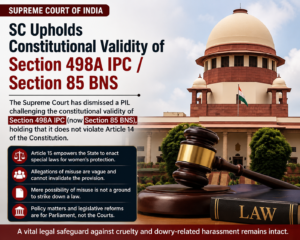
The Supreme Court has repeatedly held that vague and omnibus allegations against relatives in matrimonial cases may justify quashing where the essential ingredients of the alleged offence are not disclosed. In Geeta Mehrotra & Anr. v. State of U.P. & Anr., the Supreme Court dealt with proceedings involving Section 498A IPC and other offences and recognised the importance of specific allegations against individual accused persons.
Geeta Mehrotra & Anr. v. State of U.P. & Anr. — Supreme Court judgment
The Delhi High Court has similarly exercised its quashing jurisdiction where allegations under Section 498A were vague or insufficient to establish the statutory ingredients. In Shashi Arora v. State, the Court observed that allegations falling short of the statutory threshold cannot attract Section 498A and also addressed vague allegations under Section 406 IPC.
Shashi Arora v. State — Delhi High Court judgment
The broader legal position is that matrimonial disputes must be examined issue by issue. Senior Citizen Eviction Rights concern protection of an elderly person’s life and property, while criminal proceedings require the prosecution to satisfy the legal ingredients of the offences alleged.
What This Delhi High Court Judgment Means for Senior Citizens
For elderly parents facing serious family disputes, the ruling clarifies the available legal framework.
Senior Citizen Eviction Rights do not necessarily depend on a separate maintenance claim. A senior citizen may invoke the eviction mechanism under Rule 22(3)(1) where the statutory requirements are satisfied, even when maintenance proceedings have not been initiated.
The judgment also reinforces the statutory objective of protecting senior citizens from circumstances that threaten their peaceful enjoyment of their property.
At the same time, every case must be assessed on its own facts, including property rights, allegations of ill-treatment and any competing rights available under other laws.
For families involved in matrimonial, property or senior-citizen disputes, obtaining case-specific legal advice before initiating or contesting proceedings remains important.
Disclaimer: This news piece is for general information and does not constitute legal advice.
You may contact us for consultation or advice by visiting Contact Us