Wife can live separately from her husband when there is a reasonable and legally sustainable basis for withdrawing from the matrimonial relationship. The Jharkhand High Court has recently reiterated that a spouse cannot be compelled to resume matrimonial life where the evidence indicates mental torture, dowry demands and circumstances affecting the spouse’s dignity.
In Stuti Sarah v. Johnson Kachhap, decided on September 23, 2026, a Division Bench of Justices Sujit Narayan Prasad and Pradeep Kumar Srivastava set aside a Family Court decree directing the wife to resume married life with her husband.
Why the Wife Could Live Separately
The parties, a Christian couple, married in 2018 and lived together for around three months initially. According to the wife’s evidence, she was subjected to mental torture and repeated demands for ₹10 lakh as dowry.
The wife further alleged that she was made to leave the matrimonial home in August 2019 when she was five months pregnant. She subsequently gave birth to a daughter in December 2019. The couple had remained separated thereafter.
The husband had filed proceedings seeking restitution of conjugal rights, contending that the wife had withdrawn from his society without reasonable cause. The Family Court accepted the husband’s case and directed the wife to resume the matrimonial relationship.
The wife challenged that decision before the Jharkhand High Court.
Wife Can Live Separately Where There Is Reasonable Cause
The High Court examined the evidence led by both sides and found that the wife’s allegations were supported by her father’s testimony. The Court noted evidence concerning repeated demands for ₹10 lakh, mental torture, abandonment during pregnancy and subsequent threats.
On that basis, the Court concluded that the wife had sufficient and reasonable cause to withdraw from her husband’s society.
The Court also emphasised an important principle in proceedings concerning restitution of conjugal rights: the objective cannot simply be to compel spouses to live together irrespective of the circumstances.
According to the Court, a spouse cannot be forced to resume matrimonial life where doing so would compromise dignity or expose the person to continuing mental torture. The Court observed that a Family Court must carefully examine the evidence and the circumstances in which a spouse has chosen to live separately.
Dignity and Matrimonial Rights
The judgment recognises that matrimonial rights must operate within the broader framework of dignity and personal well-being.
The Court noted that the right to the society of one’s spouse is connected with the institution of marriage, but its enforcement cannot be viewed in isolation from the relationship’s actual circumstances.
In this case, the long period of separation since 2019, coupled with the evidence relied upon by the wife, led the High Court to hold that directing the parties to resume cohabitation was neither justified nor feasible. The Family Court therefore set aside its decree.
What Does This Mean for a Wife Living Separately?
The decision does not mean every wife can live separately merely because she prefers to. The key question remains whether there is a reasonable cause for withdrawing from the husband’s society.
Each case depends on its evidence and circumstances. Allegations of cruelty, dowry harassment, threats or mental torture must still be assessed judicially. In Stuti Sarah, the High Court relied upon the evidence available on record before concluding that the wife had reasonable cause to remain separate.
The judgment therefore highlights the importance of examining the complete matrimonial circumstances rather than treating separate residence, by itself, as proof of desertion or absence of marital obligation.
Connection With 498A and Matrimonial Criminal Proceedings
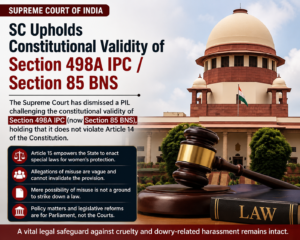
Matrimonial disputes may sometimes involve parallel criminal proceedings, including allegations under Section 498A IPC. The legal position regarding quashing such proceedings is distinct from the question of restitution of conjugal rights.
In the landmark B.S. Joshi v. State of Haryana, the Supreme Court recognised that the High Court can exercise its inherent jurisdiction to quash criminal proceedings arising from matrimonial disputes in appropriate circumstances, even where the offence is non-compoundable.
Read B.S. Joshi v. State of Haryana — Supreme Court judgment
The Delhi High Court has also dealt extensively with its quashing jurisdiction in matrimonial matters. In Yashpal Chaudhrani & Ors. v. State (Govt. of NCT of Delhi) & Anr., the Court examined the limits of quashing criminal proceedings based on settlements and discussed the principles governing matrimonial cases under Section 482 CrPC.
Read Yashpal Chaudhrani v. State — Delhi High Court judgment
These decisions demonstrate why matrimonial litigation must be examined on the facts of each case. A civil or family-law remedy such as restitution of conjugal rights and a criminal proceeding under Section 498A involve different legal questions and cannot automatically be treated as interchangeable.
Key Takeaway
The Jharkhand High Court’s decision makes it clear that a wife can live separately where the evidence establishes a reasonable cause. Mental torture, alleged dowry demands, abandonment during pregnancy and the overall circumstances of the matrimonial relationship were significant factors in the Court’s decision.
For spouses involved in matrimonial litigation, the case also underlines the importance of preserving evidence, properly presenting the circumstances leading to separation and understanding that different matrimonial and criminal proceedings may require separate legal analysis.
Source: Stuti Sarah v. Johnson Kachhap, Jharkhand High Court, decided September 23, 2026.
Disclaimer: This news piece is for general information and does not constitute legal advice.
You may contact us for consultation or advice by visiting Contact Us