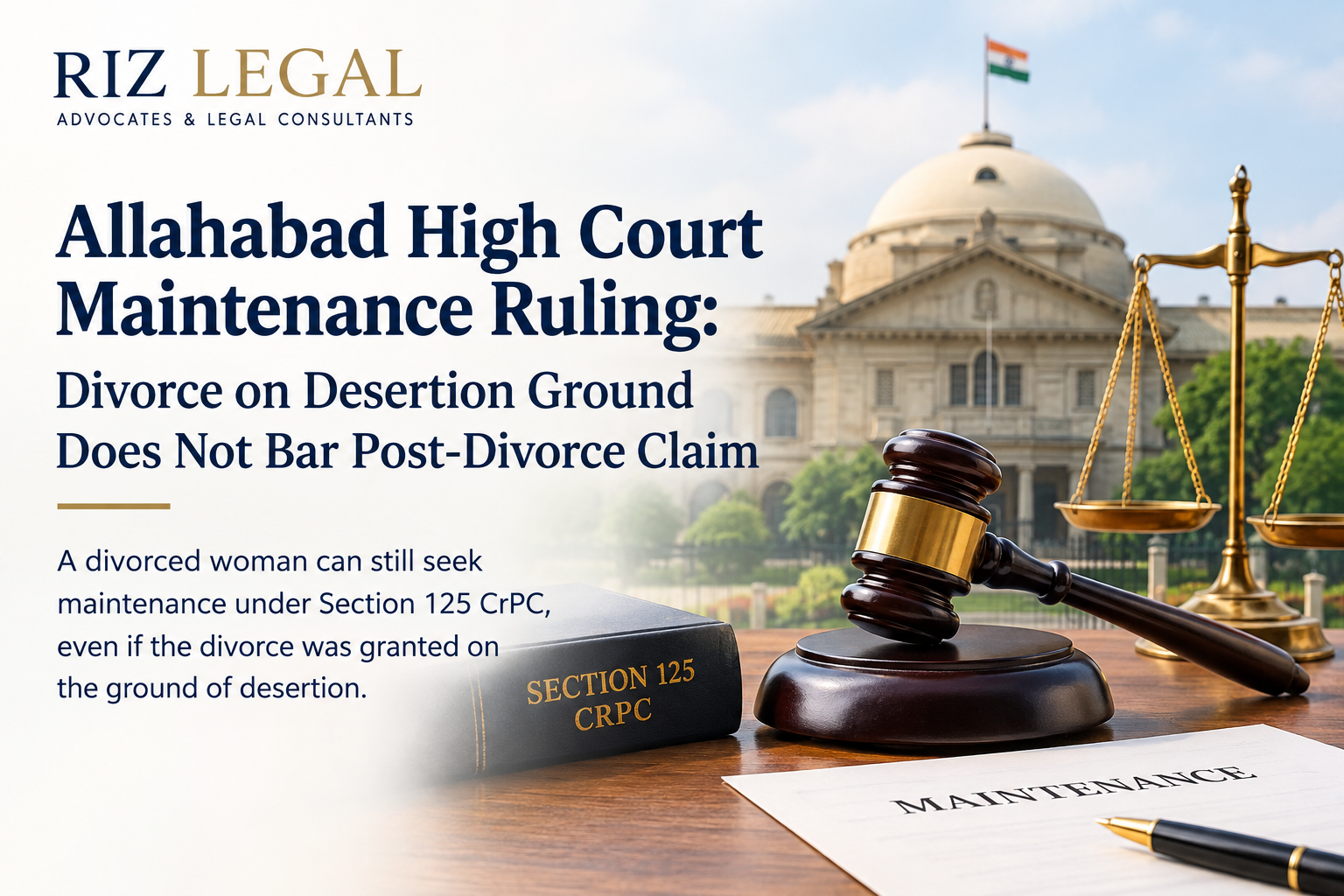
Allahabad High Court maintenance law has received an important clarification: a divorced woman does not automatically lose her right to seek maintenance under Section 125 of the Code of Criminal Procedure merely because the divorce decree was granted against her on the ground of desertion.
The ruling came in Smt. Suneeta v. State of U.P. & Another, Criminal Revision No. 254 of 2019, decided by Justice Ram Manohar Narayan Mishra on September 18, 2026. The Court set aside the Family Court’s complete rejection of the wife’s maintenance claim and directed reconsideration.
Allahabad High Court Maintenance: What Was the Dispute?
The parties had a matrimonial dispute in which the husband subsequently obtained an ex-parte divorce decree on the ground of desertion. The wife had already initiated proceedings seeking maintenance under Section 125 CrPC.
The Family Court, Sultanpur, rejected her maintenance application, considering the finding of desertion and the circumstances surrounding the parties’ separation. The wife challenged that order before the Allahabad High Court.
The husband argued that because the divorce was granted on the ground that the wife deserted him, she should not be permitted to claim maintenance.
Allahabad High Court Maintenance After Divorce
The High Court did not accept the proposition that a desertion-based divorce decree creates an absolute bar to post-divorce maintenance.
The Court relied substantially on the Supreme Court’s decision in Rohtash Singh v. Ramendri, which explains that the disqualifications contained in Section 125(4) CrPC operate while the matrimonial relationship continues. Once the marriage is dissolved, a divorced woman is treated as a “wife” for the limited purpose of Section 125 CrPC under the statutory definition.
The Court therefore held that, even if the wife had been found responsible for desertion and the divorce decree had become effective, she could seek maintenance after divorce, subject to the statutory requirements.
The Court directed that maintenance could be considered from the date of divorce, September 25, 2014, until remarriage, subject to her entitlement under law. It also recognised the minor child’s separate entitlement to maintenance, subject to adjustment for amounts already received.
Supreme Court Position on Maintenance
The decision is consistent with the Supreme Court’s approach in Rajnesh v. Neha, where the Court explained the social-justice purpose of maintenance provisions and issued guidelines on financial disclosure and assessing maintenance claims.
For a detailed understanding of the principles governing maintenance, see the Supreme Court’s decision in Rajnesh v. Neha.
The Delhi High Court has likewise emphasised that maintenance proceedings require consideration of factors such as the parties’ financial circumstances, independent income, liabilities, standard of living and payment capacity. The Court discussed these principles in Bharat Hegde v. Saroj Hegde.
For reference, see Bharat Hegde v. Saroj Hegde.
What Does the Ruling Mean?
The ruling does not mean that every divorced wife is automatically entitled to maintenance. A claim under Section 125 CrPC remains subject to the statutory conditions and evidence of income, financial dependence, and other relevant circumstances.
The key point is narrower: a finding of desertion leading to divorce does not, by itself, permanently extinguish a divorced woman’s ability to seek maintenance under Section 125 CrPC.
The Allahabad High Court also directed the parties to place affidavits disclosing their assets, income and liabilities before the Family Court, in accordance with the principles laid down by the Supreme Court.
The High Court remitted the matter to the Family Court for fresh consideration and directed expeditious disposal. Pending the final decision, the High Court directed payment of ₹4,000 per month as interim maintenance to the wife, subject to adjustment against any final amount awarded.
Key Takeaway
The Allahabad High Court maintenance ruling reinforces an important distinction between a spouse’s conduct during the marriage and the statutory position of a divorced woman seeking maintenance after dissolution of marriage.
A divorce decree based on desertion may have consequences under matrimonial law, but it does not, on its own, create an absolute statutory bar to a post-divorce claim under Section 125 CrPC.
Disclaimer: This article is intended for general legal awareness and does not constitute legal advice. The outcome of every maintenance or matrimonial proceeding depends on its specific facts, pleadings and evidence.
You may contact us for consultation or advice by visiting Contact Us