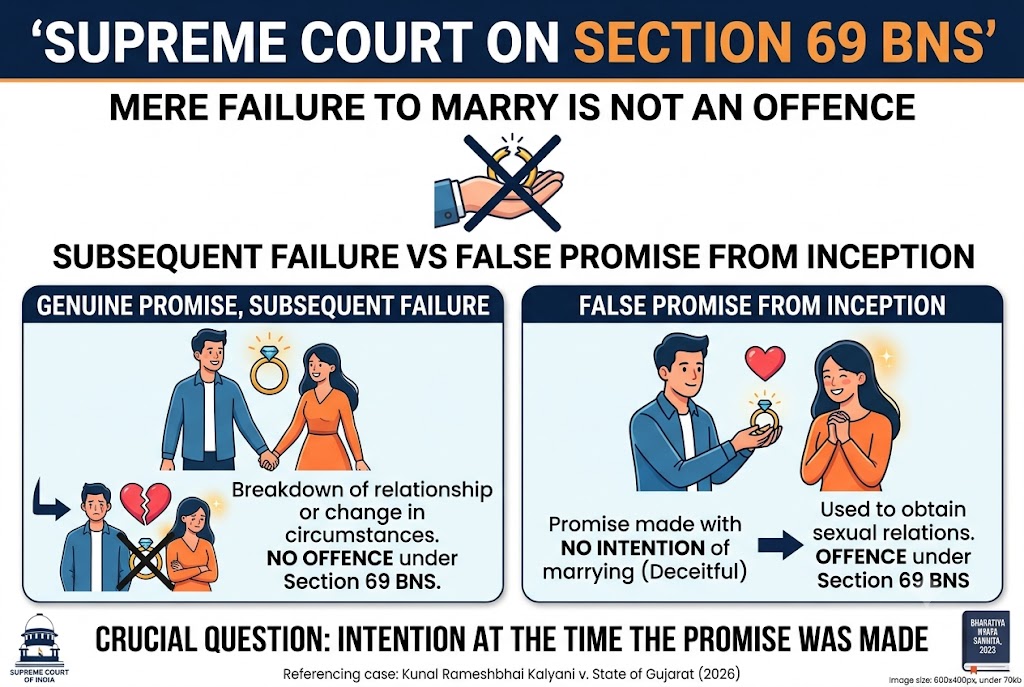
The Supreme Court has clarified the scope of Section 69 BNS, holding that a subsequent failure to fulfil a promise of marriage does not, by itself, constitute an offence under the provision. The Court emphasised that for Section 69 BNS to apply, there must be material indicating that the promise to marry was made without any intention of fulfilling it from the beginning.
The Court delivered the ruling in Kunal Rameshbhai Kalyani v. State of Gujarat, Criminal Appeal @ SLP (Crl.) No. 11526 of 2026, decided on September 7, 2026.
Section 69 BNS and the distinction between a false promise and a broken promise
Section 69 of the Bharatiya Nyaya Sanhita, 2023 creates a specific offence involving sexual intercourse obtained through “deceitful means” or through a promise to marry made without an intention to fulfil it.
The Supreme Court distinguished between two situations:
- False promise: The promise is made from the outset without any intention of marrying, and is used deceptively to obtain sexual relations.
- Subsequent failure: A genuine promise is subsequently not fulfilled because circumstances change or the relationship breaks down.
According to the Court, the second situation cannot automatically be converted into an offence under Section 69 BNS. The crucial question is the intention of the person making the promise when they made it.
Section 69 BNS requires deception at the inception
In the Supreme Court case, the complainant and the accused initially connected through a digital platform and later developed a friendship and romantic relationship. The complainant alleged that the accused expressed his desire to marry her, after which they had sexual relations.
The accused later declined to marry, allegedly because his mother was opposed to the marriage. The police subsequently registered a case under Section 69 BNS.
The Supreme Court examined the allegations contained in the FIR and found that they did not disclose the necessary deceitful conduct. The Court noted that the allegations indicated a consensual relationship and did not establish that the promise of marriage was false when it was originally made. It consequently quashed the FIR.
Supreme Court’s earlier position on promise to marry
The principle applied in the Section 69 BNS case is consistent with the Supreme Court’s earlier jurisprudence under the IPC.
In Pramod Suryabhan Pawar v. State of Maharashtra, (2019) 9 SCC 608, the Supreme Court held that a promise of marriage must be a false promise made in bad faith, with no intention of being honoured when it was made, and must have a direct nexus with the decision to engage in sexual relations. The Court quashed the FIR in that case.
Another important authority is Deepak Gulati v. State of Haryana, (2013) 7 SCC 675, where the Supreme Court explained the distinction between a genuine promise subsequently breached and a promise false from the beginning.
For reference, readers can access the landmark judgments here:
Pramod Suryabhan Pawar v. State of Maharashtra
Deepak Gulati v. State of Haryana
Delhi High Court approach
The Delhi High Court has also recognised the distinction between a false promise and a subsequent breach. In State v. Sandeep, 2019 SCC OnLine Del 10332, the Court observed that a promise to marry cannot indefinitely operate as an inducement for a physical relationship and quashed proceedings where the allegations did not establish the necessary nexus between the promise and consent.
The Delhi High Court has subsequently reiterated that a promise must be false from inception and made in bad faith to attract the established legal principles concerning rape allegations based on a promise of marriage.
For reference:
Delhi High Court — State v. Sandeep, 2019 SCC OnLine Del 10332
What the Section 69 BNS ruling means
The Supreme Court’s ruling makes the intention at the inception of the promise a central consideration in cases under Section 69 BNS. The mere fact that a relationship later ends, a marriage does not take place, or a person later changes their decision cannot, by itself, establish the statutory offence.
At the same time, the ruling does not mean that every allegation involving a promise to marry will fail. Where evidence indicates that the promise was deceptive from the beginning and was made without any intention of fulfilment, the ingredients of Section 69 BNS may still be attracted.
The judgment therefore reinforces the need to examine the facts, the nature of the relationship, the circumstances surrounding the promise and, importantly, the intention existing when the promise was allegedly made.
Case: Kunal Rameshbhai Kalyani v. State of Gujarat, Criminal Appeal @ SLP (Crl.) No. 11526 of 2026, decided on September 7, 2026.
Disclaimer: This news article is intended for general legal awareness and does not constitute legal advice. The outcome of every maintenance or matrimonial proceeding depends on its specific facts, pleadings and evidence.
You may contact us for consultation or advice by visiting Contact Us