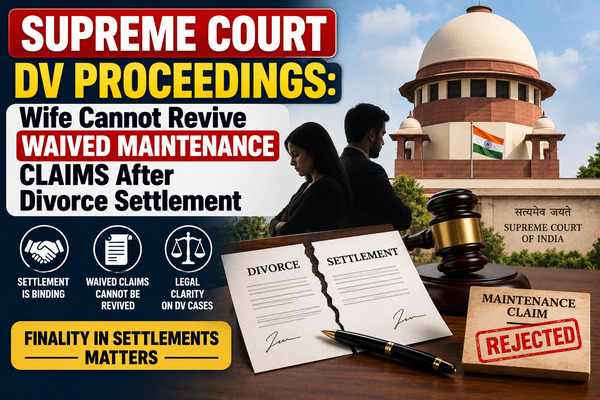
Supreme Court DV proceedings have come under important judicial scrutiny after the Supreme Court of India held that a wife who voluntarily relinquishes monetary and maintenance claims as part of a matrimonial settlement cannot subsequently revive those claims through proceedings under the Protection of Women from Domestic Violence Act, 2005 (DV Act), unless the settlement itself is legally challenged.
The judgment was delivered by a Bench comprising Justice Sandeep Mehta and Justice Manmohan in Reji Baby v. Subi Mary & Ors., Criminal Appeal No. 1346 of 2021, 2026 INSC 918, decided on August 24, 2026.
Supreme Court DV Proceedings and Finality of Settlement
The dispute arose after the husband and wife entered into a Settlement Agreement dated July 23, 2016. Under the settlement, the wife agreed not to make future monetary or maintenance claims against her husband.
The parties subsequently approached the Family Court and obtained a divorce decree by mutual consent. The wife also submitted an affidavit before the Family Court expressly reaffirming that she had relinquished her maintenance claim and that no future claims or liabilities would arise from the marriage.
Despite the settlement and divorce, proceedings under the DV Act were subsequently initiated. The husband approached the Supreme Court to quash those proceedings.
The Supreme Court held that continuation of the proceedings amounted to an abuse of the process of law. The Court observed that once the wife had voluntarily relinquished her monetary claims, including maintenance, she could not subsequently revive those claims through another proceeding.
Settlement Cannot Be Challenged Merely By Alleging Coercion
An important aspect of the ruling concerns allegations that the settlement was entered into under pressure or duress.
The Supreme Court noted that although the wife alleged coercion, she had not instituted proceedings seeking to set aside the Settlement Agreement or invalidate the divorce decree. The Court therefore held that mere allegations of coercion, without a legal challenge to the settlement itself, were insufficient to reopen claims already settled.
The judgment reinforces the principle that a validly executed matrimonial settlement cannot ordinarily be treated as meaningless merely because one party subsequently seeks to pursue claims that were expressly given up.
The Supreme Court also relied upon its earlier decision in Dhananjay Rathi v. Ruchika Rathi, which emphasised the binding nature of duly authenticated settlements and the need to discourage proceedings that seek to undo the effect of a valid compromise.
What the Supreme Court DV Proceedings Ruling Means
The decision does not mean that every Domestic Violence Act proceeding filed after a settlement will automatically be quashed. The facts and terms of each settlement remain crucial.
Where a settlement clearly records the voluntary waiver of monetary or maintenance claims, the parties act on it, and it is followed by a mutual-consent divorce, a subsequent attempt to revive the same pre-settlement claims may face serious legal obstacles.
At the same time, the Supreme Court made an important distinction concerning an adult daughter who was not a party to the settlement. Her independent monetary claims could not be treated as waived merely because her mother had entered into the settlement.
Related Landmark Judgments
- Dhananjay Rathi v. Ruchika Rathi – Supreme Court of India — on the binding nature of mediated matrimonial settlements.
- Anamika Khurana v. Rajiv Khurana – Delhi High Court — on the effect of crystallised matrimonial claims under a settlement/MOU and the inability to revive an original cause of action merely because of subsequent breach.
Conclusion
The Supreme Court’s ruling strengthens the legal importance of carefully drafted matrimonial settlements. Once parties voluntarily settle their disputes, expressly waive specified monetary or maintenance claims and obtain a divorce on that basis, those settled claims cannot ordinarily be revived through Supreme Court DV proceedings or subsequent proceedings without first legally challenging the settlement itself.
The judgment is therefore significant for matrimonial litigation, mediation, divorce settlements and proceedings under the DV Act.
At Riz Legal, we help clients navigate complex matrimonial disputes with a focus on practical, legally sound outcomes.
You may contact us for consultation or advice by visiting Contact Us