False promise of marriage cannot by itself convert every consensual sexual relationship between two adults into a criminal offence, the Delhi High Court has observed. The Court stressed that the crucial question is whether the alleged promise of marriage actually influenced or “tainted” the consent of the woman at the time the sexual relationship was entered into.

Justice Girish Kathpalia made the observations while granting regular bail to an accused facing allegations under Sections 376 and 506 of the Indian Penal Code.
False Promise of Marriage Must Have Tainted the Consent
The Delhi High Court clarified that the law does not criminalise a consensual relationship merely because a subsequent dispute arises over an alleged promise to marry.
According to the Court, it is necessary to examine whether the promise was a false assurance from the beginning and whether that assurance was the determining factor that led to the sexual relationship. A later breakdown of the relationship or failure to marry cannot, by itself, establish that the original consent was vitiated.
The Court cautioned that judges must carefully examine whether a consensual relationship is subsequently being given a criminal character by adding an allegation of a promise to marry.
Delhi High Court Examines the Circumstances
The case concerned a 29-year-old working woman who alleged that the accused had established a relationship with her after assuring her that he would marry her. The prosecution alleged that the accused was already married and had two children and had represented that divorce proceedings with his wife were pending.
The Court, however, noted several circumstances relevant to the question of consent. The woman and the accused had reportedly been colleagues for several months, and the Court considered it difficult to accept at the prima facie stage that she would remain unaware of his marital status.
The Court also took note of communications between the parties and the timing of the FIR. On an overall assessment, it formed the prima facie view that the relationship appeared consensual and was not shown, at that stage, to have been induced by a false assurance of marriage.
The Court nevertheless made it clear that its observations were confined to the bail proceedings and that the trial court would independently assess the evidence at the appropriate stage.
What the Ruling Means
The ruling reinforces an important distinction in cases involving a false promise of marriage: a promise must be examined in the context in which consent was given. Courts are required to determine whether the alleged assurance actually caused the consent to sexual relations to be given, rather than treating every failed relationship as criminal conduct.
The judgment therefore highlights the importance of examining the entire factual matrix, including the parties’ conduct, their communications, the surrounding circumstances, and the timeline of the relationship.
Relevance to Matrimonial Criminal Proceedings
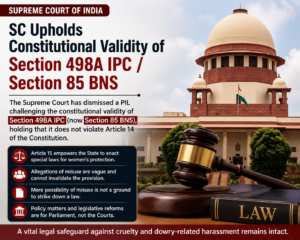
The broader principle of careful judicial scrutiny also applies to matrimonial criminal litigation, including proceedings under Section 498A IPC. The Supreme Court has repeatedly recognised that the High Court can exercise its inherent jurisdiction in appropriate cases to prevent abuse of the criminal process. See Gian Singh v. State of Punjab, a leading Supreme Court judgment on quashing criminal proceedings arising from disputes with a predominantly private or matrimonial character.
Similarly, the Delhi High Court has continued to quash Section 498A/406 IPC proceedings in appropriate matrimonial settlements, including cases where the parties have resolved their disputes and obtained or pursued mutual divorce.
Conclusion: The Delhi High Court’s ruling makes clear that an allegation of a false promise of marriage requires careful examination of the circumstances surrounding consent. A consensual relationship does not automatically become rape merely because the relationship subsequently ends or the promised marriage does not take place.
This article is for general legal information and does not constitute legal advice.
At Riz Legal, we help clients navigate complex matrimonial disputes with a focus on practical, legally sound outcomes.
You may contact us for consultation or advice by visiting Contact Us
Source: Live Law