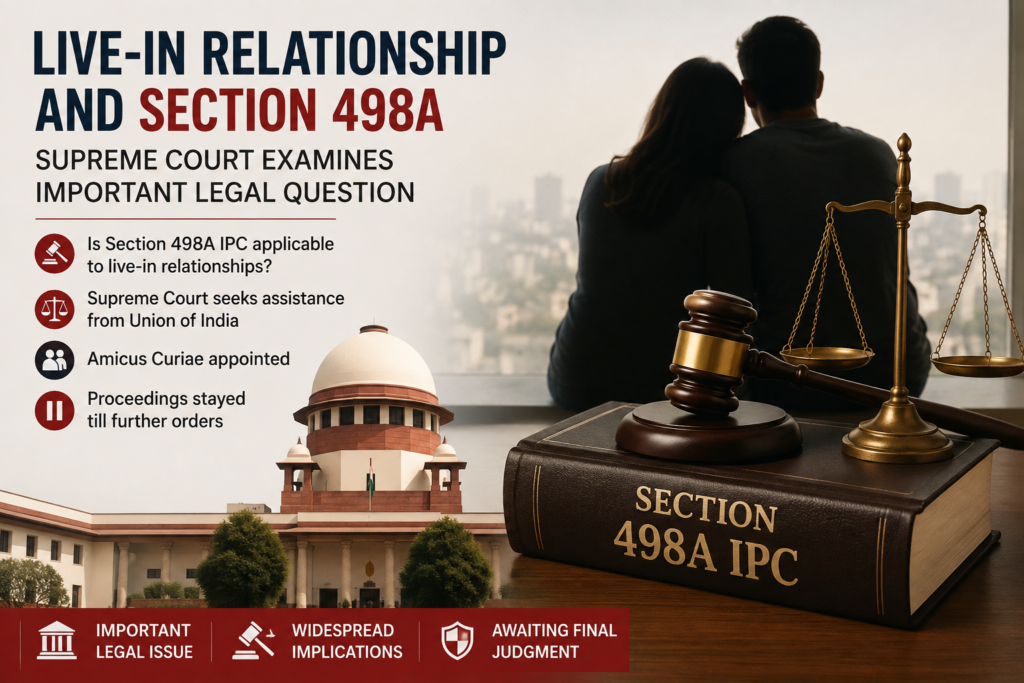
Live-In Relationship and Section 498A has come under the Supreme Court’s scrutiny in a significant case that could have far-reaching implications for criminal law and matrimonial disputes. The Court is considering whether a man in a live-in relationship or a relationship in the nature of marriage can be prosecuted under Section 498A of the Indian Penal Code (IPC) or its corresponding provision under the Bharatiya Nyaya Sanhita, 2023 (BNS).
The matter arose from a challenge to a Karnataka High Court judgment, with the petitioners seeking clarity on the applicability of cruelty provisions to relationships that are not formally solemnised marriages.
Live-In Relationship and Section 498A: Supreme Court Seeks Wider Assistance
Recognising the importance of the legal issue, the Supreme Court has taken several notable steps:
- Issued notice in the matter.
- Impleaded the Union of India through the Ministry of Law and Justice as a respondent.
- Requested the Additional Solicitor General to assist the Court.
- Appointed Ms Nina R. Nariman as amicus curiae (pro bono) to assist in resolving the legal question.
- Directed the parties to file their responses before the next hearing.
The Bench observed that the issue requires careful consideration because it concerns the interpretation of criminal provisions governing matrimonial cruelty in the context of live-in relationships.
Proceedings Stayed by the Supreme Court
Pending adjudication of the legal issue, the Supreme Court has stayed all further proceedings in the case. The interim protection will continue until the matter is heard further.
Although the Court has not expressed any final opinion on the merits, its decision to stay the proceedings and seek assistance from the Union of India and an amicus curiae highlights the significance of the questions involved.
Why This Case Matters
Section 498A IPC was enacted to address cruelty by a husband or his relatives against a married woman. The present case raises an important legal question: Can similar criminal liability extend to a person in a live-in relationship, or to a relationship in the nature of marriage, where no formal marriage exists?
The Supreme Court’s eventual ruling may provide much-needed clarity on the scope of Section 498A IPC and its corresponding provision under the Bharatiya Nyaya Sanhita, particularly in cases involving non-marital domestic relationships.
Conclusion
The Live-In Relationship and Section 498A case is one of the most closely watched matrimonial and criminal law matters before the Supreme Court. While the Court has not yet decided the substantive issue, its interim order underscores the legal importance of determining whether cruelty provisions under the IPC and BNS extend to live-in relationships. The final judgment is expected to have a significant impact on the interpretation and application of matrimonial criminal law in India.
At Riz Legal, we assist clients navigating complex matrimonial disputes with a focus on practical and legally sound outcomes.
You may contact us for consultation or advice by visiting Contact Us