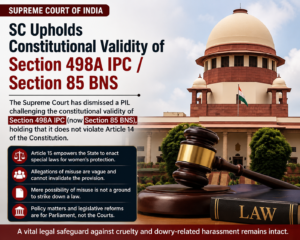
Section 498A FIR quashed by the Delhi High Court has brought relief to a husband after he and his former wife settled their matrimonial disputes for ₹39 lakh. The Court also quashed a second criminal case after the couple resolved their differences, obtained a mutual-consent divorce and fulfilled the settlement terms.
The ruling highlights the High Court’s inherent power to end criminal proceedings arising from matrimonial disputes when the parties have genuinely settled their differences.
Delhi High Court Quashes FIRs After ₹39 Lakh Settlement
According to The Indian Express, Justice Prateek Jalan heard the husband’s plea to quash two FIRs his wife filed. The couple married in 2010 and had a son in 2011. They began living separately in February 2014 following matrimonial discord and differences in temperament.
The first FIR was registered in 2014 under provisions relating to cruelty and criminal breach of trust. A second FIR was registered in 2023, involving allegations that included assault and criminal intimidation.
During the proceedings, the couple reached a settlement in August 2024 through the Family Court’s counselling process at Rohini, Delhi. They subsequently obtained a divorce by mutual consent on December 20, 2024.
Under the settlement, the husband agreed to pay ₹39 lakh as full and final settlement of the wife’s matrimonial claims, including permanent alimony, maintenance and istridhan.
Why Was the Section 498A FIR Quashed?
The Court noted that the wife had confirmed that the settlement was voluntary and made without coercion or undue pressure. She also stated that she had no objection to quashing the criminal cases.
Of the agreed ₹39 lakh, ₹34 lakh had already been paid. The wife received the remaining ₹5 lakh in Court on September 16, completing the settlement.
The Court observed that the parties had amicably resolved their disputes and that a conviction was unlikely. Continuing the criminal proceedings would serve no useful purpose and would unnecessarily burden the justice system.
Accordingly, the Court granted the requested relief. It also clarified that the settlement and the order would not affect the minor child’s rights, with custody remaining with the mother.
Supreme Court and Delhi High Court Precedents on Quashing Section 498A FIRs
The decision is consistent with established principles governing the quashing of criminal proceedings arising from matrimonial settlements.
- Supreme Court — Gian Singh v. State of Punjab (2012): The Supreme Court explained the High Courts’ inherent power to quash criminal proceedings to secure the ends of justice, including certain cases involving non-compoundable offences where disputes are predominantly private in nature.
- Delhi High Court — Anurag Bhasin v. Govt. of NCT of Delhi (2022): The Court quashed an FIR under Sections 498A, 406 and 34 IPC after the parties amicably settled their matrimonial dispute without pressure.
These decisions do not mean that every Section 498A case can be withdrawn simply by reaching a financial settlement. The Court examines the nature of the allegations, the genuineness of the compromise, the interests of justice and other relevant circumstances.
What This Ruling Means for Husbands Facing Matrimonial Litigation
The judgment shows that a genuine settlement can help end prolonged matrimonial litigation. However, a Section 498A FIR is not automatically quashed merely because the parties have settled. A formal order from the competent High Court is required, and the outcome depends on the facts of each case.
Husbands considering settlement should ensure that the agreement clearly records financial obligations, divorce terms, pending cases and any child-related arrangements. Seek legal advice before signing or implementing a settlement.
Source: The Indian Express, September 22, 2026.
RIZ Legal assists clients with matrimonial disputes, criminal defence, and legal remedies related to allegations under Section 498A IPC. An early legal review can help identify issues that need attention and determine the appropriate next steps.
Disclaimer: This news piece is for general information and does not constitute legal advice.
You may contact us for consultation or advice by visiting Contact Us