Parental alienation is one of the most damaging yet least understood forms of emotional abuse affecting children caught in family disputes. It occurs when one parent deliberately or repeatedly influences a child to fear, reject, or resent the other parent without any valid reason. While it is most seen during separation, divorce, or custody battles, its effects can last a lifetime.
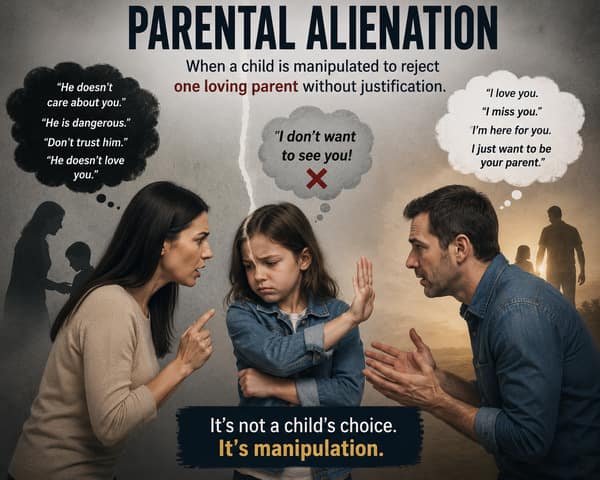
At its heart, parental alienation is not merely a dispute between two adults. It is a situation in which a child becomes an unintended victim of parental conflict.
The Social and Legal Reality
The breakdown of a marriage often brings anger, resentment, disappointment, and a desire to “win” against the other parent. Unfortunately, children are sometimes drawn into these battles. One parent may constantly criticise the other, interfere with visitation, create false impressions, or encourage the child to take sides.
Over time, the child may begin to view the targeted parent through a distorted lens, even when that parent has done nothing to justify such rejection.
The consequences can be severe. Children subjected to parental alienation often experience anxiety, depression, low self-esteem, confusion about their identity, and difficulties in forming healthy relationships as adults. They may lose the opportunity to benefit from the love, support, and guidance of one parent, with lasting emotional consequences.
From a legal standpoint, parental alienation presents a unique challenge. Courts must carefully distinguish between genuine concerns about a parent’s conduct and deliberate attempts to poison the child’s relationship with that parent. This requires a balanced, evidence-based approach focused on the child’s welfare rather than the allegations of either parent.
Where Family Law Meets Child Abuse
Traditionally, child abuse has been associated with physical violence or neglect. However, psychologists and courts increasingly recognise that emotional and psychological abuse can be equally harmful.
Parental alienation falls within this category because it undermines a child’s emotional well-being and interferes with the child’s right to maintain a healthy relationship with both parents.
Indian courts have begun acknowledging the seriousness of this issue. In Col. Ramneesh Pal Singh v. Sugandhi Aggarwal [SLP no. 28466 of 2023], the Supreme Court emphasised that allegations of parental alienation should not be accepted casually and must be supported by specific acts and evidence. At the same time, the Court recognised that manipulative conduct by a parent can significantly harm a child’s development and welfare.
This shift reflects an important principle: parental alienation is not merely a custody dispute—it is fundamentally a child welfare issue.
Post-Divorce Dynamics
Parental alienation often emerges after separation or divorce, particularly when emotions remain unresolved, and custody litigation continues for years.
Common signs include repeatedly denying access, obstructing communication, making derogatory remarks about the other parent, withholding important information about the child, or encouraging the child to reject the other parent.
The longer such behaviour continues, the more difficult it becomes to repair the damaged relationship. Children may eventually internalise the hostility and become emotionally estranged from the alienated parent, sometimes for years or even decades.
This is why timely intervention by courts, counsellors, mediators, and mental health professionals is critical. Shared parenting arrangements, counselling, and structured visitation plans can often help preserve the child’s relationship with both parents.
The Debate Around Legal Bias
One of the most contentious aspects of parental alienation is the perception of bias within custody proceedings. Many fathers argue that traditional assumptions often favour mothers as primary caregivers, making it harder for fathers to prove alienation. On the other hand, women’s rights advocates caution that claims of parental alienation should not be used to dismiss genuine allegations of abuse or neglect.
Both concerns deserve attention.
The answer lies in adopting a child-centric, gender-neutral, and evidence-driven approach. Courts must move beyond stereotypes and focus solely on what serves the best interests of the child. Allegations of alienation should be evaluated objectively, regardless of whether the accused parent is the mother or the father.
Conclusion
Parental alienation is a silent form of emotional abuse that can leave deep psychological scars on children. It sits at the intersection of family law, child protection, and mental health. As awareness of this issue grows, courts and policymakers must ensure that children are protected not only from physical harm but also from manipulation that deprives them of a meaningful relationship with a loving parent.
No child should be forced to choose between parents, and no child should become collateral damage in an adult conflict.
The above article is for information purposes only.
You may contact us for consultation or advice by visiting Contact Us