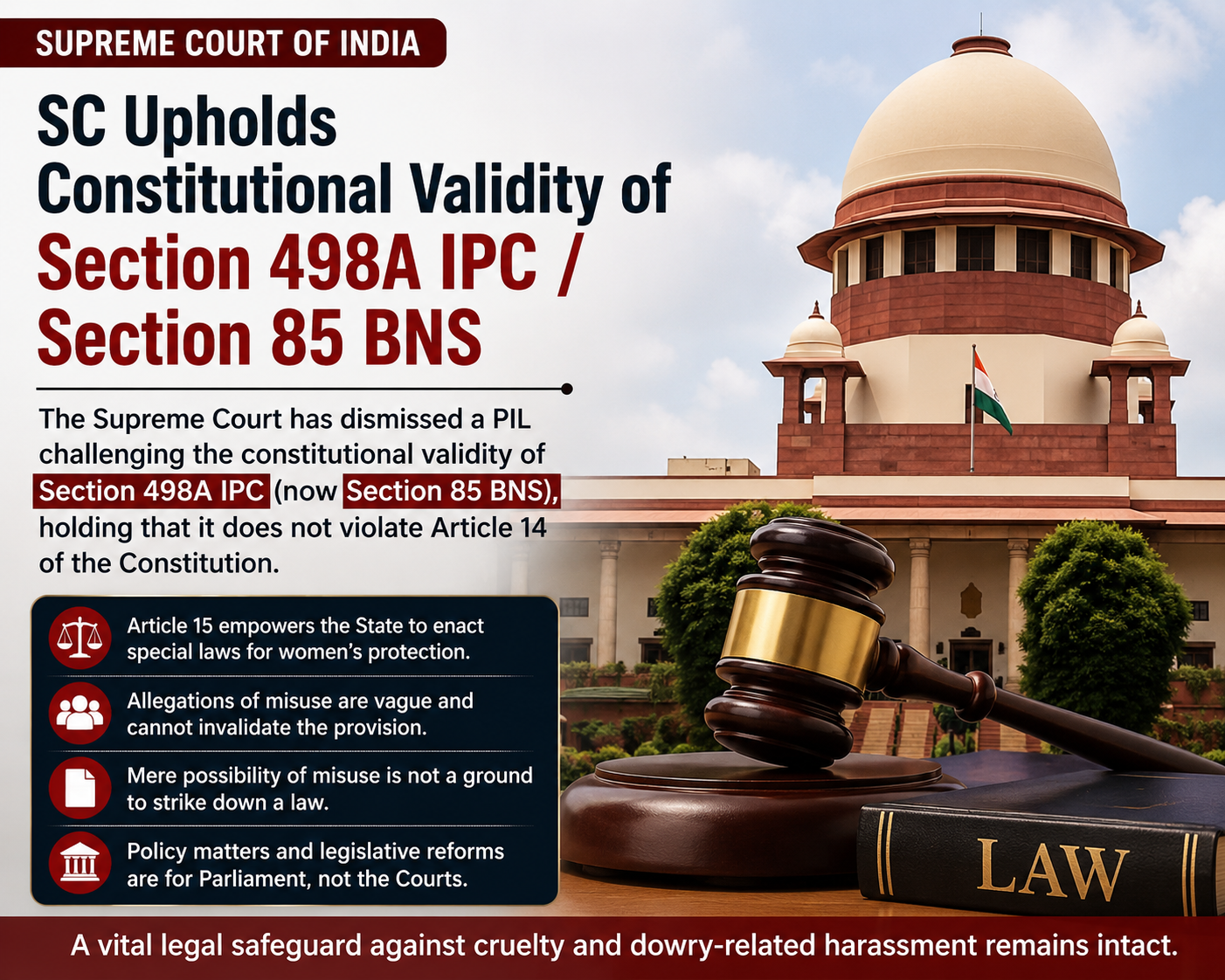
The Supreme Court has dismissed a Public Interest Litigation (PIL) challenging the constitutional validity of Section 498A of the Indian Penal Code (now Section 85 of the Bharatiya Nyaya Sanhita, 2023), reaffirming that the provision does not violate Article 14 of the Constitution.
A Bench comprising Justice Surya Kant and Justice N. Kotiswar Singh held that the challenge was “wholly misconceived and without merit.” The Court observed that Article 15 of the Constitution expressly empowers the State to enact special laws for the protection of women and other disadvantaged groups. Accordingly, the legislative policy underlying Section 498A could not be invalidated merely on the basis of a constitutional challenge.
The petitioner had sought wide-ranging directions, including making matrimonial laws gender-neutral, introducing mandatory preliminary investigations before the registration of cases under Sections 498A of the Indian Penal Code and 12 of the Protection of Women from Domestic Violence Act, creating safeguards against false complaints, and framing guidelines on maintenance and alimony.
Rejecting these prayers, the Court held that allegations regarding misuse of Section 498A were general and unsupported by sufficient material. It reiterated the settled principle that the mere possibility of misuse of a statutory provision does not render it unconstitutional. Questions relating to misuse, the Court observed, must be examined on the facts of individual cases rather than through a broad constitutional challenge.
The Bench further acknowledged that while instances of misuse may occur, Section 498A continues to serve as an important legal safeguard against cruelty and dowry-related harassment. It also noted that dowry remains a persistent social evil and that many cases of domestic cruelty continue to go unreported.
In declining to issue policy directions sought by the petitioner, the Supreme Court emphasised the constitutional doctrine of separation of powers, observing that matters involving legislative reform and policy choices fall within the domain of Parliament. Consequently, the PIL was dismissed in its entirety.