
Marriage is intended to provide companionship, support, and security. However, when a woman is subjected to cruelty, harassment, or abuse in her matrimonial home, the law steps in to protect her rights. Section 85 BNS (Bharatiya Nyaya Sanhita, 2023) is a provision designed to safeguard married women from cruelty inflicted by their husbands or their relatives.
While the provision serves an important social purpose, it has also been the subject of debate regarding allegations of misuse. Understanding both aspects is essential for a balanced view of the law.
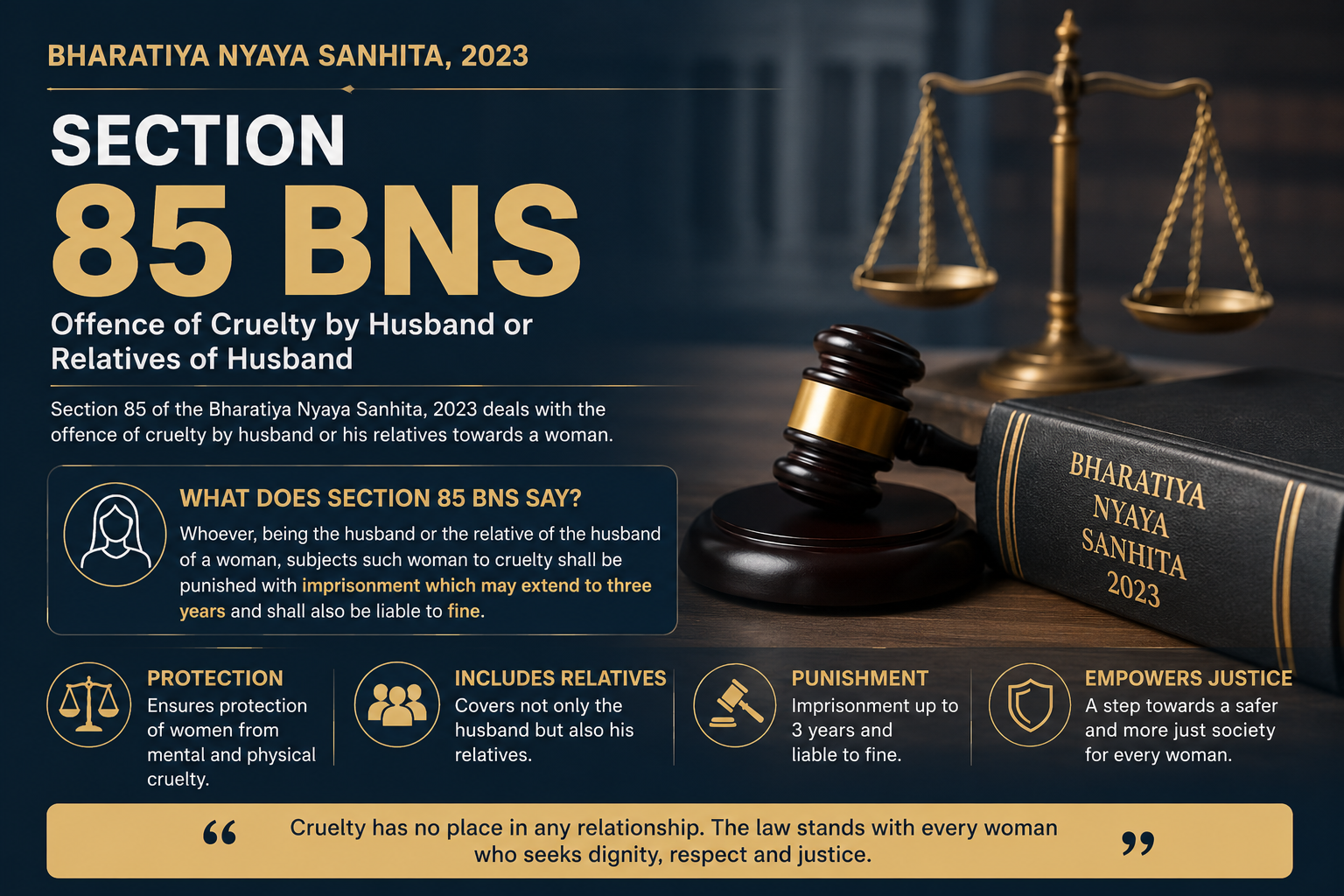
What is Section 85 of Bhartiya Nagarik Suraksha Sanhita (BNS in short)?
Section 85 BNS is a criminal offence for the husband or his relatives who subject a married woman to cruelty.
The term “cruelty” includes:
- Conduct that is likely to drive a woman to commit suicide.
- Conduct causing grave injury or danger to her life, limb, or mental or physical health.
- Harassment with a view to coercing her or her family to meet unlawful demands for property, money, or valuable security.
- Harassment upon failure to meet the demands.
The provision is aimed at addressing domestic abuse and dowry-related harassment within marriage.
Why Was Section 85 Introduced?
For many years, women facing abuse within their marital homes had limited legal remedies. Dowry-related violence, physical abuse, emotional torture, and economic harassment often went unreported.
Section 85 seeks to:
- Protect women from domestic cruelty.
- Deter dowry-related harassment.
- Ensure timely legal intervention to prevent abuse from escalating into serious physical injury or fatal consequences. Promote dignity and safety within marriage.
- Hold offenders accountable for abusive conduct.
The law recognises that cruelty is not limited to physical violence and may include mental and emotional abuse as well.
The Need for Section 85 BNS:
The provision remains relevant because domestic abuse frequently occurs behind closed doors, making detection and intervention difficult.
Victims often face:
- Financial dependence on their spouse.
- Social pressure to remain silent.
- Fear of retaliation.
- Lack of family support.
- Mental trauma resulting from continuous harassment.
It provides a legal mechanism to address such situations and helps ensure that women are not left without protection.
Concerns Regarding Misuse:
Like many criminal laws, Section 85 has sometimes been criticised for alleged misuse.
In certain cases, complaints have been filed in matrimonial disputes in which multiple relatives—including elderly parents, sisters living separately, or distant family members—have been implicated without specific allegations.
Indian courts have repeatedly observed that criminal law should not be used as a tool to settle personal scores or to exert pressure in matrimonial disputes.
However, it is equally important to note that allegations of misuse do not diminish the genuine suffering of women who face real abuse. Courts, therefore, strive to strike a balance between protecting victims and preventing false implication.
Judicial Approach
The Supreme Court and various High Courts have consistently emphasised that:
- Any complaint under BNS 85 must be examined on its own facts.
- Mechanical arrests should be avoided.
- Specific allegations should exist against each accused person.
- Investigation must be fair, impartial, and evidence-based.
Courts have repeatedly cautioned against indiscriminately roping in all family members without credible material.
Safeguards Available Under Law
To prevent arbitrary action and protect innocent persons, several safeguards have evolved through judicial decisions and criminal procedure:
- Requirement of Investigation: Police are required to investigate allegations before filing a charge sheet. Mere accusation does not automatically establish guilt.
- Judicial Scrutiny: Courts examine whether the complaint discloses a prima facie offence and whether there is sufficient material to proceed.
- Anticipatory Bail: Where appropriate, accused persons may seek anticipatory bail to avoid unnecessary arrest.
- Quashing of Proceedings: High Courts have the power to quash criminal proceedings where allegations are vague, absurd, or clearly motivated.
- Protection Against Automatic Arrest: Courts have repeatedly directed that arrests be made neither mechanically nor without complying with legal requirements.
- Right to Fair Trial: Every accused person enjoys the constitutional right to defend themselves and challenge the allegations through evidence and cross-examination.
Conclusion
Section 85 BNS plays a vital role in protecting married women from cruelty and dowry-related harassment. It reflects the law’s commitment to ensuring dignity, safety, and equality within marriage. At the same time, courts have developed safeguards to prevent abuse of the legal process and to protect innocent individuals from false implication.
The objective of the law is not to punish every marital disagreement but to address genuine instances of cruelty and harassment. A balanced application of Section 85 helps achieve justice for victims while preserving the rights of the accused.
The above article is for information purposes only.
You may contact for consultation or advice by visiting Contact Us